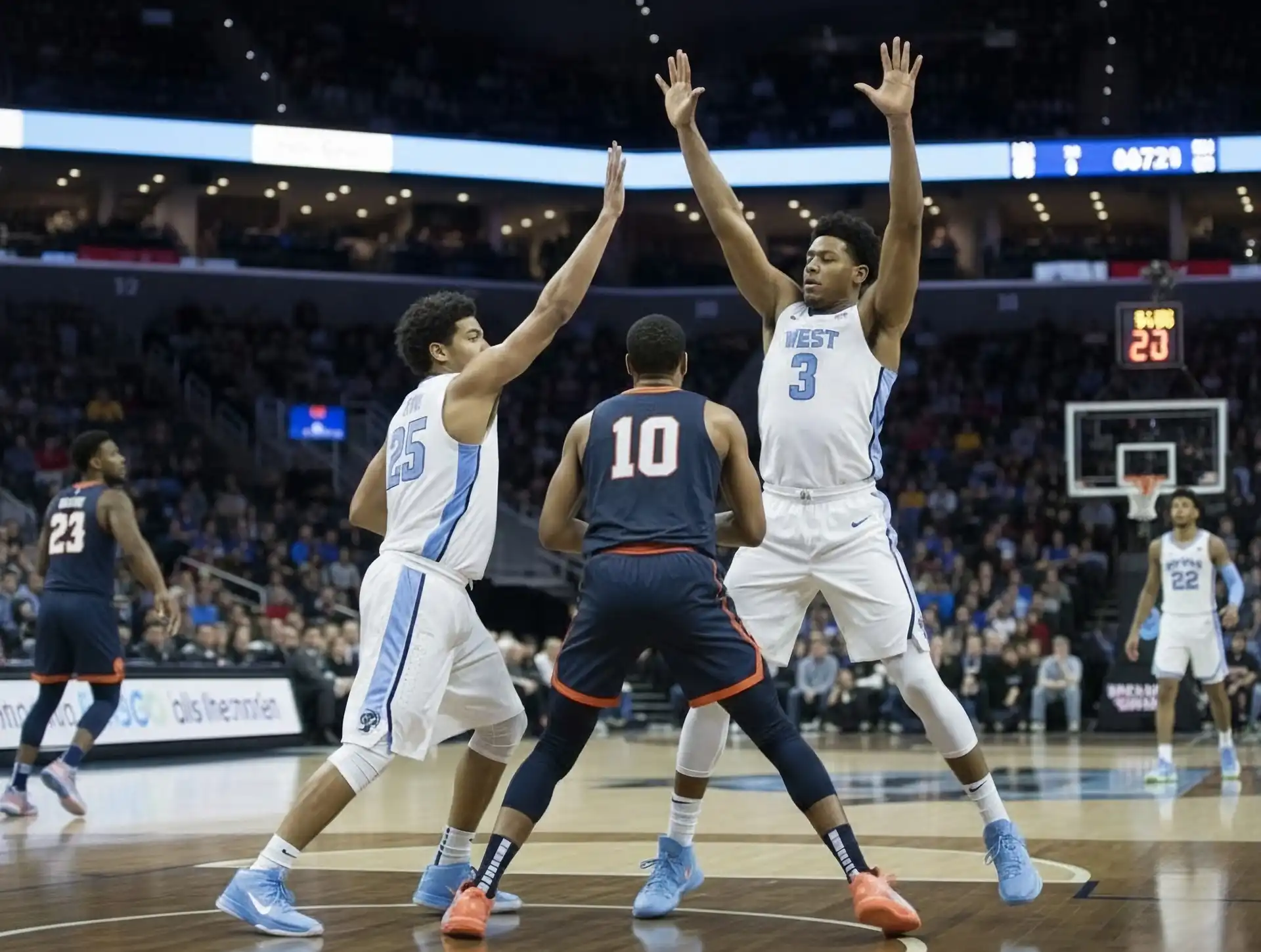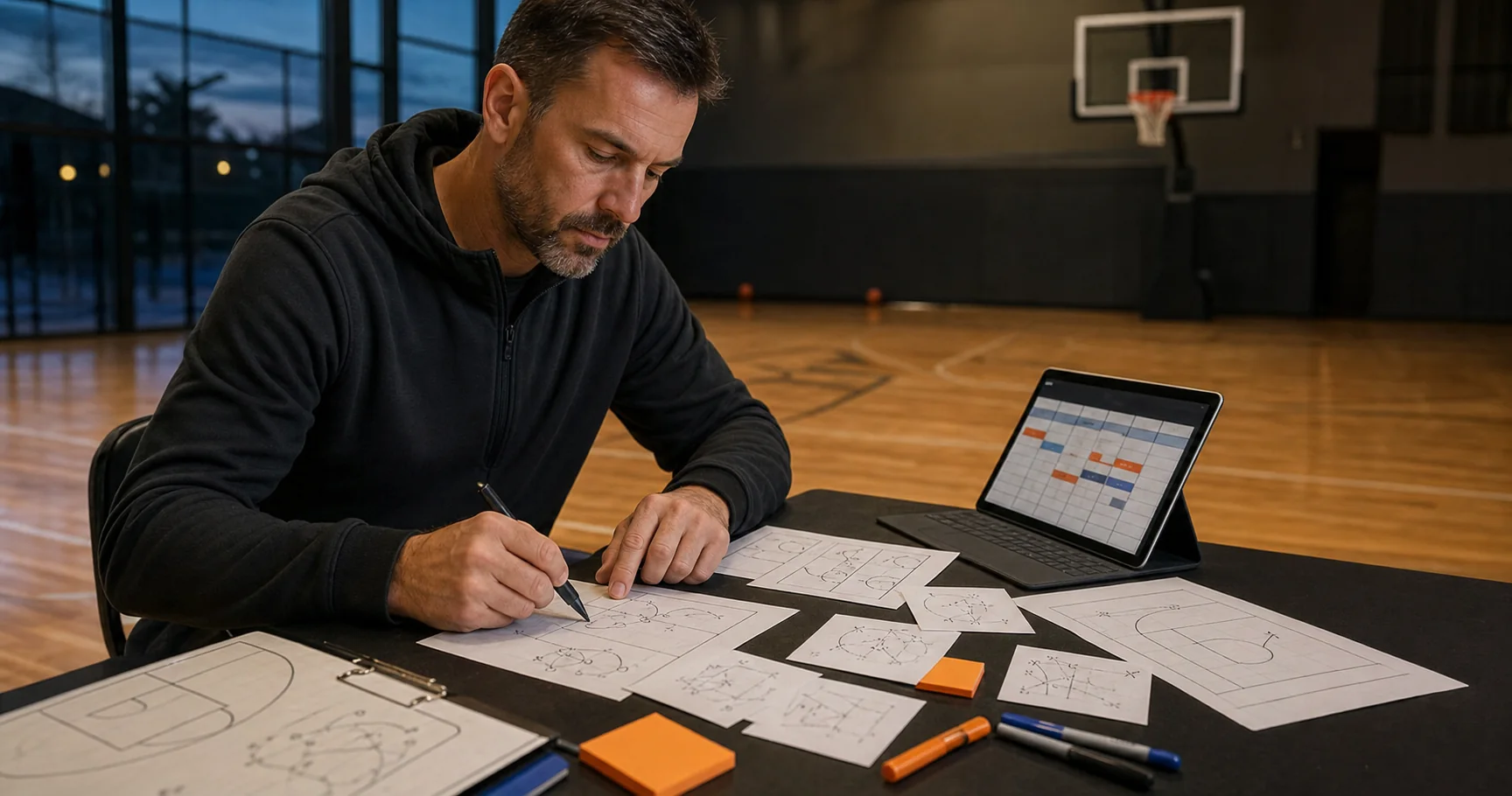
You open your notes to plan tonight's practice and find 30 saved drills, six screenshots, three videos, and a half-finished idea from last week.
The problem is not a lack of options. It is deciding what belongs in the next 75 minutes, in what order, and why.
Many coaches collect drills because drills feel useful and concrete. But a collection is not a practice plan. A strong practice connects every activity to one clear objective, then builds the decisions and behaviors players will need in the game.
This article gives you a simple framework for doing that. You will learn how to turn scattered drill ideas into a practice with a goal, progression, realistic timing, purposeful constraints, and coaching cues your players can actually use.
Why More Drill Ideas Do Not Create Better Practices
A new drill can solve a real problem. It can introduce a different scoring system, create more repetitions, or give players a fresh challenge. That is why a good basketball Drill Library is valuable.
The trouble starts when the search for the next drill replaces the work of planning.
Imagine your team struggled to attack closeouts in the last game. You find four excellent finishing drills, a competitive shooting game, and a 3v3 small-sided game. All six activities might be useful. But if they do not share a clear objective or progress toward the same game problem, the session can still feel disconnected.
Players stay busy, yet the learning does not build from one segment to the next. Coaches end up giving different corrections in every drill. When practice ends, everyone has worked hard, but it is difficult to say what actually improved.
A drill answers, “What are we doing?” A practice plan must also answer, “Why this, why now, and what should it lead to?
The goal is not to stop collecting drills. It is to give each drill a job inside a larger structure.
The Five Parts of a Clear Basketball Practice Plan
A useful plan does not need to be complicated. Before adding activities, define these five elements:
- Goal: What should players understand or do better by the end?
- Progression: How will the practice move from a clear problem to more game-like decisions?
- Timing: How much time does each segment deserve, including transitions?
- Constraints: What rules or conditions will invite the behavior you want?
- Coaching cues: What will you observe, ask, or say without stopping every repetition?
These elements turn a list into a learning sequence.

1. Start With One Practice Goal
“Work on offense” is too broad. “Improve finishing” is better, but it still does not tell players what problem they are learning to solve.
A useful goal describes a game behavior. For example:
- recognize an advantage before the defense recovers
- create space after drawing a second defender
- attack a closeout with an immediate shoot, drive, or pass decision
- keep the ball moving against full-court pressure
- communicate early during defensive transition
The goal should influence every major decision in the plan. If an activity does not support it, save that activity for another day.
A simple test is to complete this sentence:
By the end of practice, our players should be better at [behavior] when [game situation] happens.
For a youth team, that might be: “By the end of practice, our players should be better at attacking the next gap when a drive forces help.”
That sentence is specific enough to guide your drill choices, but open enough for players to find different solutions.
2. Build a Progression, Not a Playlist
A playlist is a series of activities. A progression makes the next activity more demanding than the last while preserving the same problem.
You do not always need to move from isolated technique to 5v5. A game-based progression can begin with a small, readable situation and gradually add information, space, players, or consequences.
For the goal of attacking the next gap, a progression could look like this:
| Segment | Learning focus | Added challenge |
|---|---|---|
| 1v1 closeout game | Read the defender's arrival | Live defender and immediate decision |
| 2v2 drive-and-kick | See help and find the next advantage | One help defender and one receiver |
| 3v3 advantage game | Maintain spacing after penetration | More off-ball decisions and rotations |
| 5v5 guided play | Transfer the behavior into team offense | Full game information and consequences |
The activity changes, but the thread stays visible. You can ask similar questions throughout the session: Where was the open space? When did the advantage disappear? What did the help defender show you?
Progression does not always mean “harder.” If players are guessing, simplify the space or numbers. If they are solving the problem too easily, add a defender, reduce time, or remove a predictable starting advantage.
3. Plan Time Honestly
Coaches often plan 75 minutes of activities for a 75-minute practice. That leaves no time for water, explanation, setup, player questions, or transitions between baskets.
Give every segment a time box, then leave a small buffer. A realistic 75-minute structure might be:
- 8 minutes: arrival activity connected to the goal
- 12 minutes: first small-sided problem
- 15 minutes: progression with another decision
- 5 minutes: water and transition buffer across the session
- 20 minutes: larger game or team application
- 10 minutes: competitive finish
- 5 minutes: recap and player reflection
This is not a universal template. Team age, training frequency, facility constraints, and the complexity of the topic will change the balance. The important part is that your clock reflects the session you can actually run.
Also decide in advance what you will shorten if practice runs late. Protect the segment that offers the clearest game transfer, not necessarily the drill you were most excited to try.
4. Use Constraints With a Purpose
A constraint is not simply an extra rule. It should shape attention or behavior while keeping meaningful choices available.
If your goal is to create the next advantage after a drive, useful constraints could include:
- award two points when a paint touch creates a shot for a teammate
- start with an angled closeout instead of a static check ball
- limit the playing area to expose spacing problems
- give the defense a bonus for forcing the ball back into the same gap
- change the defensive coverage between possessions
Each rule invites a different behavior. That is why constraints should be planned, observed, and adjusted rather than stacked on top of one another.
Ask three questions before adding one:
- What behavior am I trying to invite?
- What information will players need to read?
- Could this rule create an unwanted shortcut?
If players begin chasing the scoring rule instead of solving the basketball problem, change it. The constraint serves the goal, not the other way around.
For a deeper look at designing game-like learning environments, see the constraints-led approach for basketball coaches.
5. Prepare Coaching Cues Before Practice
Planning activities without planning your coaching often leads to constant improvisation. You see five problems at once, stop the drill, and deliver a long explanation that players struggle to apply.
Write down two or three observation points before practice. For the drive-and-kick example, they might be:
- Did the driver engage help before passing?
- Did off-ball players move to create a clear passing window?
- Did the receiver attack the next advantage or allow the defense to recover?
Then prepare short cues or questions:
- “Where is the next gap?”
- “Can the helper guard two?”
- “Arrive ready to shoot, drive, or move it.”
These are not scripts you must repeat. They are anchors that keep your feedback connected to the practice goal.
A Fast Planning Workflow You Can Reuse
When time is short, use this order:
Step 1: Name the game problem
Start with your last game, a recurring team need, or the next opponent. Write one sentence describing the behavior you want to improve.
Step 2: Choose the final game form
Decide where you want the practice to end: 3v3, 4v4, 5v5, a transition game, or a special-situation game. This becomes the destination for your progression.
Step 3: Work backward
What smaller situation gives players more chances to see the same information? Choose one or two activities that expose that problem clearly.
Step 4: Add time and transitions
Assign realistic durations. Account for equipment, court changes, water, and explanation. Decide what can be cut without breaking the learning sequence.
Step 5: Add one purposeful constraint at a time
Connect each constraint to a behavior and write down what you will watch for. Keep an easy regression and a meaningful progression ready.
Step 6: Prepare your coaching language
Write two observation points and two short questions. This reduces overcoaching and makes your feedback more consistent.
Step 7: Review the whole plan
Read the session from start to finish. Does every segment support the goal? Does the information become more game-like? Is there enough time to play?
If not, remove something. A shorter coherent plan is more useful than a packed schedule of unrelated drills.
Where a Practice Planner Saves Time
The hard part of planning is not typing drill names into a document. It is holding the relationship between goal, activities, durations, constraints, and coaching cues in your head while you keep revising the session.
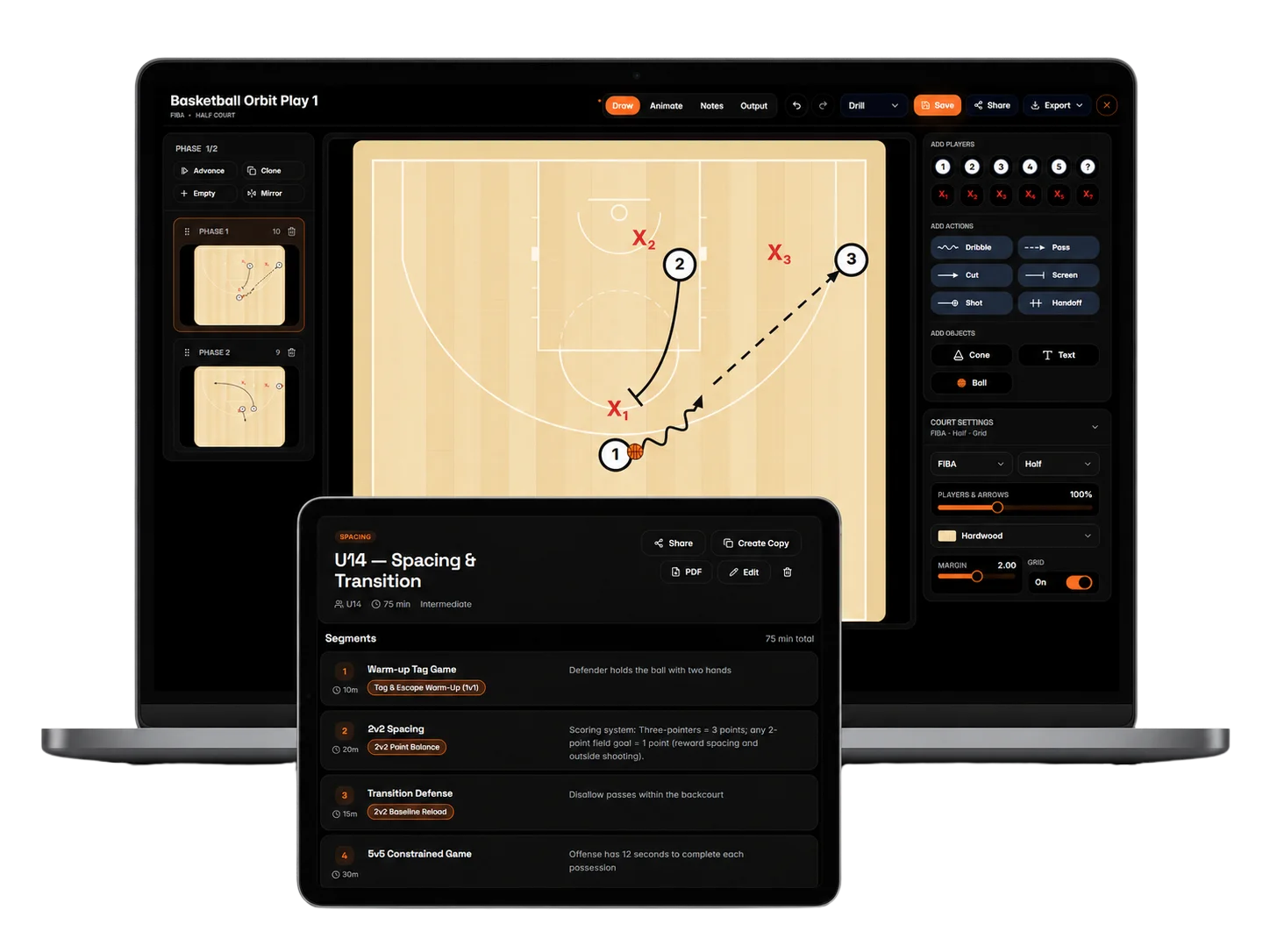
The Basketball Orbit Practice Planner puts those pieces in one working space. You can organize a complete session into timed segments, add drills from the library, create your own visual drills and plays, and keep objectives, constraints, notes, and coaching cues with the plan.
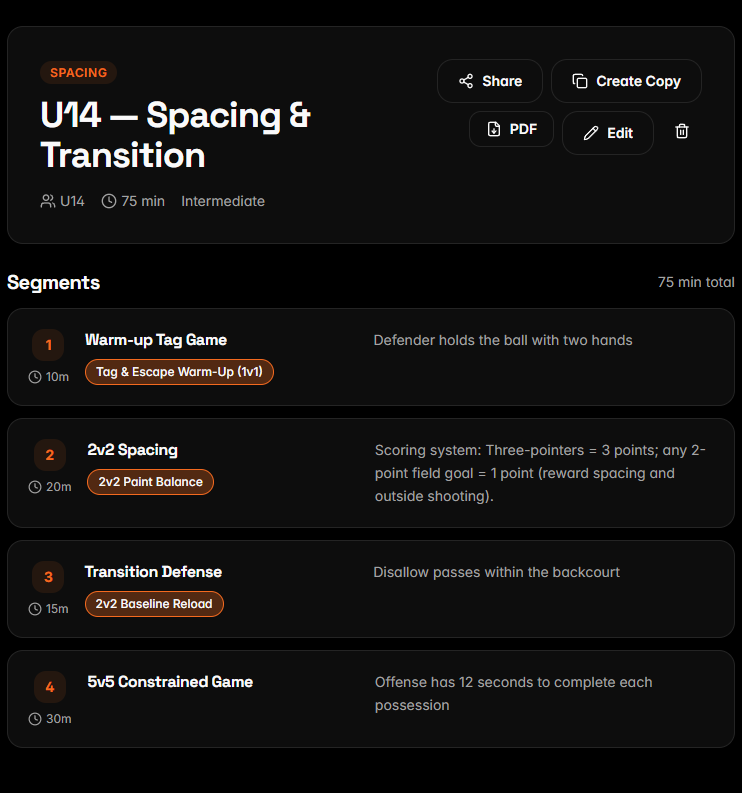
That does not make the planning decisions for you. It reduces the friction around those decisions. Instead of rebuilding the format every week or searching through separate files, you can spend more time checking whether the session has a clear learning thread.
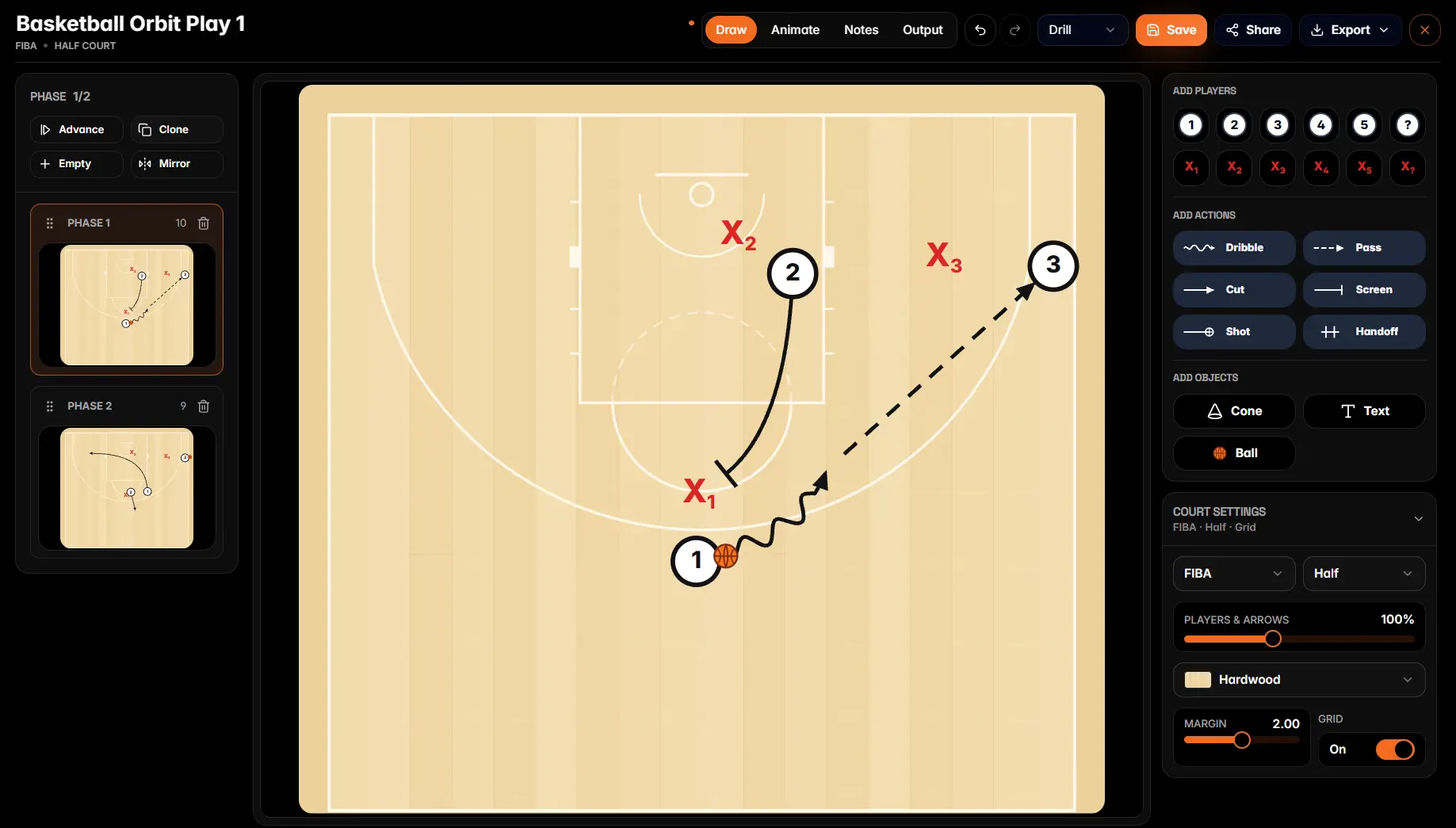
The Drill Creator is especially useful when the activity in your head does not exist in a library. You can draw your own drill or play, save the visual with its teaching details, and place it inside the practice where it belongs.
How AI Can Help Without Replacing the Coach
AI is useful when it reduces blank-page work or gives you another perspective. It becomes less useful when its output is treated as a finished answer without context.
A planning assistant does not know your team the way you do. It did not see yesterday's practice. It cannot feel the energy in the gym, know which player needs confidence, or recognize that one basket is unavailable tonight.
The coach still owns:
- the practice goal
- the standard appropriate for the team
- the choice of representative activities
- the timing and emotional rhythm of the session
- live adjustments based on what players show
- the final decision about what is safe, relevant, and useful
Orbit AI can support that process by creating an editable first draft from details such as duration, age group, level, player count, equipment, and goal. It can also review an existing plan, suggest coaching cues or constraints, and help refine an individual segment.
Use that support as a conversation starter:
- Give AI a specific goal and honest team context.
- Inspect whether the proposed progression preserves the game problem.
- Remove activities that do not fit your players or facility.
- Rewrite cues in language your team understands.
- Make the final adjustment in the gym.
The best use of AI is not “plan practice for me.” It is “help me examine and improve the plan I am responsible for.”
Common Practice-Planning Mistakes
Trying to fix everything in one session
Multiple themes produce competing cues and shallow repetitions. Choose one main objective and treat other issues as notes for future practices.
Confusing activity with learning
Fast lines and constant movement can look productive. Check whether players are perceiving information, making decisions, and adapting under realistic pressure.
Adding too many constraints
When players must remember four special rules, the game can become less representative. Start with one constraint and change it only when behavior tells you to.
Planning every minute with no room to adapt
A plan should guide your decisions, not prevent them. Build a buffer and identify which segment can expand, shrink, or disappear.
Letting AI or a template override context
Templates and generated drafts save time, but they are starting points. Age, skill level, roster size, equipment, and what happened in the previous practice still matter.
Key Takeaways
- A drill collection gives you options; a practice plan gives those options direction.
- Start with one observable game behavior, not a broad topic.
- Build a progression in which each segment prepares players for the next decision environment.
- Assign realistic time and protect room for transitions and adaptation.
- Use constraints to invite behavior, then change them based on what players actually do.
- Prepare a few observation points and coaching questions before entering the gym.
- Use AI to draft, review, and refine, while keeping the coach responsible for context and final decisions.
Build the Practice, Not Just the Drill List
Good planning does not require the perfect collection of drills. It requires a clear goal and a sequence that helps players solve the same basketball problem under increasing game pressure.
Start with your next practice. Name one behavior. Choose the final game form. Work backward. Add realistic timing, one purposeful constraint, and a few coaching cues.
Then put the whole session somewhere you can see and improve it as one connected plan.
Turn your next drill idea into a complete practice
Use the Basketball Orbit Practice Planner to organize your goal, drills, timings, constraints, and coaching notes in one place. Build manually, start with a library activity, or use Orbit AI for an editable draft while you keep full control as the coach.
Written by Chris Bernhard — Basketball Orbit