How Science, Creativity, and Game Reality Are Transforming Player Development
We don’t teach the move — we teach the mind that creates it.
Intro
A quiet revolution is now reshaping the game: the Constraints-Led Approach (CLA), a science-backed framework that views learning not as repetition, but as interaction.
In this article, we explore how the CLA challenges traditional coaching, explains the science behind real skill development, and shows how modern coaches can design practices that build smarter, more adaptable players, without losing the joy of the game.
I. The End of the Old Coaching Era
For decades, basketball coaching has looked disciplined, but most of it wasn’t true learning.
Players stood in lines, repeated the same moves, and perfected technique in silence while coaches barked corrections.
It looked productive, but it built players who could perform in practice, not in games.
That era is quietly ending as a new generation of coaches questions everything — from the purpose of drills to the coach’s role itself.
At the heart of this transformation stands the Constraints-Led Approach (CLA): a science-based framework redefining how humans learn movement and decision-making.
The Old Paradigm: Technique Without Context
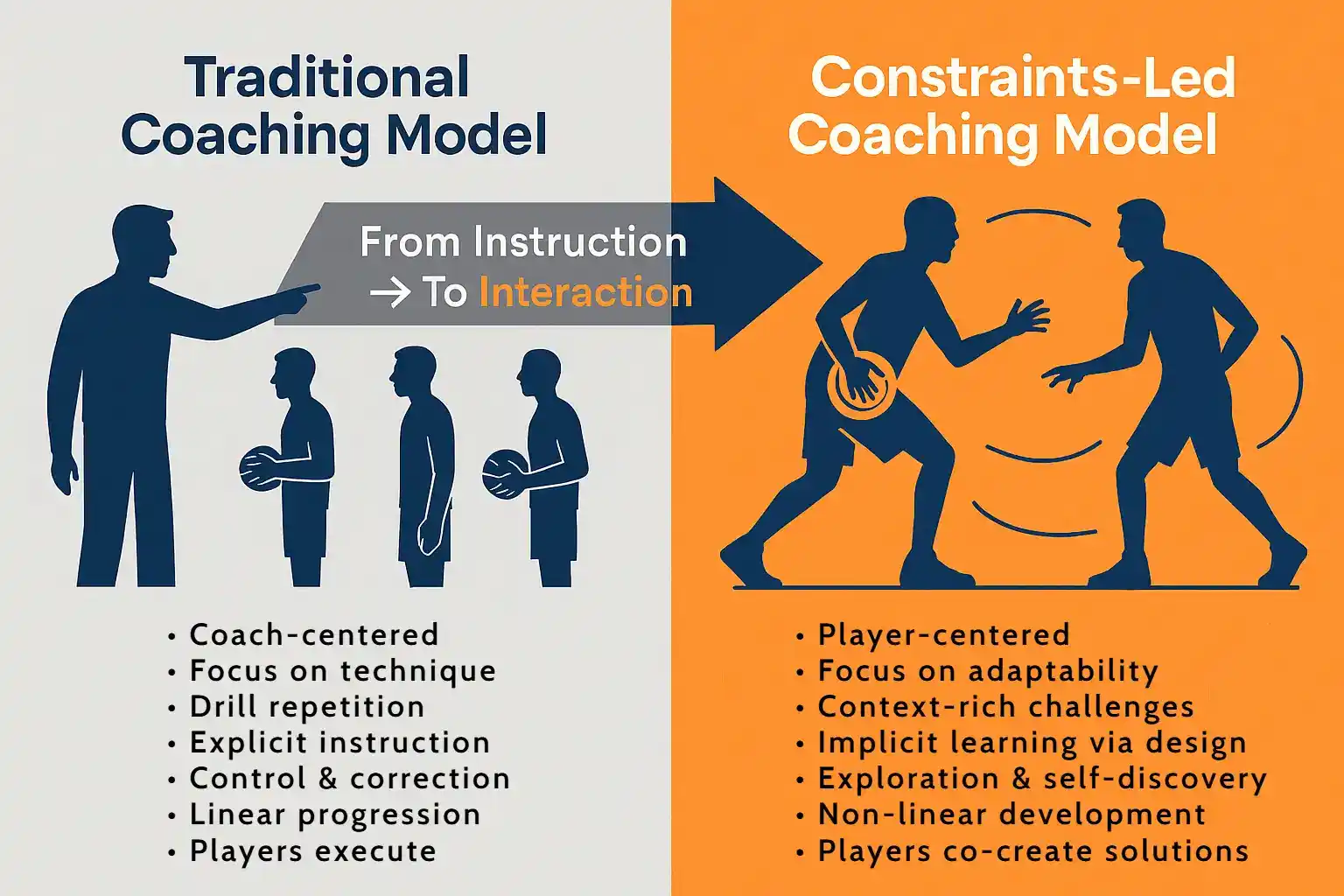
Traditional coaching assumes players must first master skills in isolation — dribbling, shooting, passing — and only then apply them in games.
The gym becomes a lab for “perfect form”, stripped of defenders, pressure, and unpredictability.
But once you remove context, you remove the problem the skill was meant to solve.
As coach George Vaz explained in The Transforming Basketball Podcast (EP 136, 2025):
We’ve been practicing moves without the problem those moves were designed to solve.
— The Transforming Basketball Podcast, EP 136 (2025) – Spotify
That single line exposes the flaw: traditional training treats movement as choreography, not problem-solving.
Players learn to repeat — not to adapt — and their technique collapses under real defensive pressure.
The Illusion of Mastery
Perfect mechanics feel like progress, but often they’re false learning.
Repetition without variability breeds fragility — real learning begins when mistakes are explored, not punished.
The CLA flips this logic: instead of avoiding chaos, it uses it.
Every constraint — spacing, time, defenders — becomes a tool to shape perception and decision-making.
It may look messy, but that mess is what real transfer looks like.
Why the Old Way Persists
If the science is clear, why do most gyms still look the same?
Because control feels safe.
Lines and order make coaches appear “in charge,” while game-like learning feels unpredictable.
Static drills • Coach-led correction • Isolated repetition • Control over discovery
Yet control kills discovery. Modern coaches aren’t dictators of technique but architects of learning environments.
As Jordan Cassidy wrote in Different Approaches to Skill Acquisition (2021):
The effective coach is no longer an autocratic instructor giving continuous verbal direction,
but an architect who designs learning environments that allow solutions to emerge.
— Cassidy (2021), Different Approaches to Skill Acquisition – Skilled Athleticism Blog
The Turning Point
This shift goes beyond drills. It redefines coaching itself.
We’re moving from telling players what to do to designing situations where they can discover what works.
From perfection to adaptation.
From rote learning to genuine understanding.
The Constraints-Led Approach doesn’t just make you better — it makes basketball feel like basketball again.
— The Transforming Basketball Podcast, EP 82 (2024) – Spotify
The revolution begins the moment we stop chasing flawless form
and start creating environments where learning feels like the game itself.
II. The Science Behind the CLA: Ecological Dynamics
Skill doesn’t live in the player — it lives in the interaction between the player and the environment.
— adapted from Seifert & Davids (2017)
The Constraints-Led Approach (CLA) is built on a deep scientific foundation called Ecological Dynamics.
This framework merges two fields of research: Ecological Psychology, which studies how humans perceive and act in their environments, and Dynamical Systems Theory (DST), which explains how complex systems — like the human body — self-organize without a central command.
Ecological Dynamics
At its core, it views every player as a dynamic system that continuously adapts to their surroundings.
Movement isn’t something stored in the brain and executed on command. It emerges in real time as players interact with defenders, space, and task demands.
Skill, therefore, is not the memorization of a technique. It’s a functional adaptation to a constantly changing environment.
The Three Constraint Categories
One of the key insights from this framework comes from Karl Newell (1986), who defined three categories of constraints that shape how behavior emerges:
- Individual (Organismic) Constraints – player-specific factors like height, fatigue, motivation, or perception-speed.
- Task Constraints – the specific goals, rules, and equipment involved in a game situation.
- Environmental Constraints – external conditions such as lighting, noise, temperature, or court dimensions.
Learning happens as players adapt to the continuous interaction of these constraints — each one inviting certain actions while limiting others.
This is the scientific engine behind the CLA — not repetition, but adaptation.
Self-Organization: The Hidden Order in Chaos
A defining principle of the CLA is self-organization — the idea that coordination patterns emerge naturally without step-by-step instruction.
When coaches modify constraints, players discover efficient movement solutions on their own.
For example: reducing dribble limits, adjusting space, or adding defenders changes the information landscape, prompting players to reorganize their movement patterns.
This is what makes CLA so powerful. The coach doesn’t tell players what to do; the environment shows them what works.

The scientific roots of this idea come directly from DST:
systems under the right constraints spontaneously settle into stable yet flexible patterns.
In basketball terms, the right challenge reveals the right solution.
Perception-Action Coupling and Affordances
In traditional coaching, “decision-making” and “technique” are often treated as separate skills.
But Ecological Dynamics shows that they are two sides of the same coin — perception and action are coupled.
A player doesn’t see first and then act — the act of perceiving is already part of the action.
This idea leads to one of the most beautiful concepts in ecological psychology: Affordances — the action opportunities that the environment offers.
A passing lane “invites” a pass; a gap “invites” a drive.
Great players aren’t faster thinkers, they are more attuned to affordances.
The coach’s role is to design environments where useful affordances become visible.
What the CLA Is — and Isn’t
The CLA is often mistaken for simply “playing games at practice.”
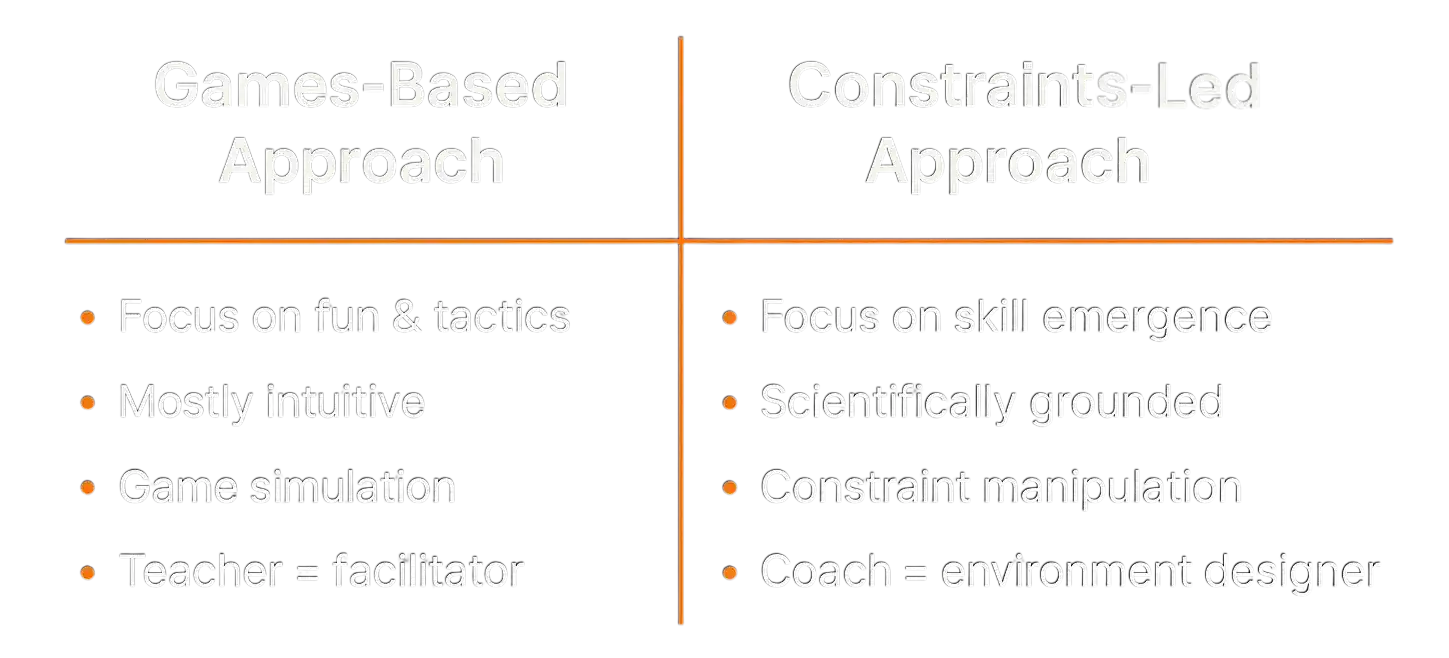
But unlike a Games-Based Approach, which focuses mostly on tactical awareness and fun, the CLA uses scientific manipulation of constraints to drive specific learning outcomes.
Every small-sided game, spacing change, or scoring rule acts as a deliberate design choice to shape behavior.
In short: it’s not chaos — it’s controlled chaos.
As summarized in Applying CLA to Basketball Shooting (2019):
movement coordination emerges “through the interaction between the organism and the environment,” guided by task-specific constraints rather than verbal correction.
This is why the CLA feels so different. It aligns coaching with how the brain and body actually learn.
Instead of controlling behavior, it creates conditions where learning self-emerges.
The Coach as Designer
In this framework, the coach’s job changes fundamentally.
Rather than being the sole source of answers, the coach becomes a designer of learning environments.
Each constraint — a rule, a space, a number of players — becomes a teaching tool.
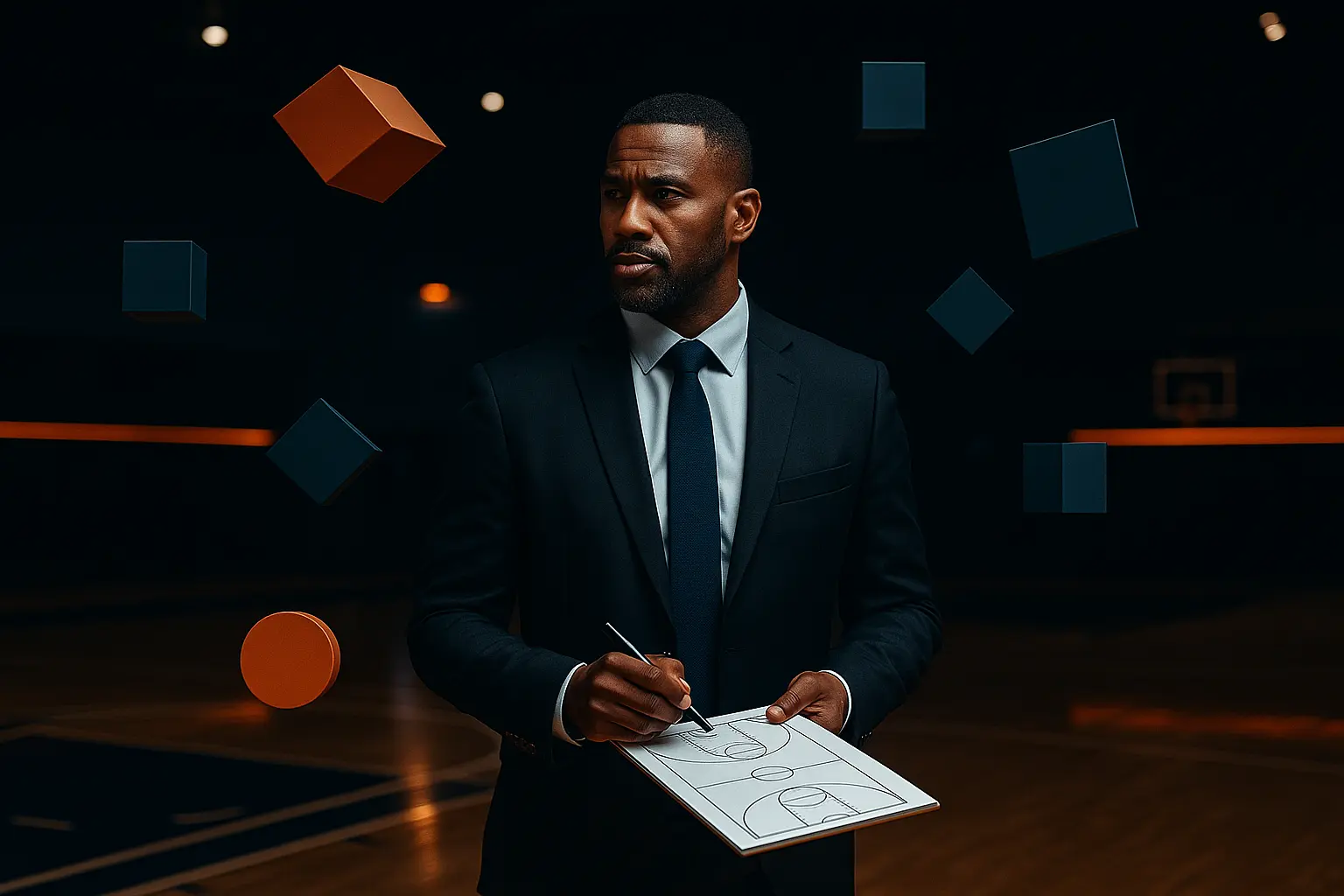
As summarized by Jordan Cassidy (2021) in Different Approaches to Skill Acquisition:
The effective coach is no longer an autocratic instructor giving continuous verbal direction,
but an architect who designs learning environments that allow solutions to emerge.
This role demands creativity and trust in the process.
📘 Summary: The Scientific Core of Modern Coaching
The Constraints-Led Approach (CLA) builds on decades of movement science, redefining skill as a living, adaptive process shaped by the dynamic interaction of player, task, and environment.
Practicing in isolation might look clean, organized, and productive, but without context, decisions, or pressure, it teaches coordination that doesn’t survive real games.
The Constraints-Led Approach reminds us that learning is not about memorizing technique — it’s about interacting with the game itself.
III. From Theory to Practice – Designing CLA Environments
The purpose of manipulating constraints is to guide behavior — that’s essentially why we do it.
— The Transforming Basketball Podcast, EP 132 (2025) – Spotify
The Constraints-Led Approach lives or dies in practice design.
Theory alone doesn’t change how players learn — the gym does.
The art lies in creating that design so that the right behaviors emerge without having to be commanded.
The Role of Constraints
In a Constraints-Led session, rules aren’t restrictions — they’re invitations.
Each constraint (whether Individual, Task, or Environmental) shapes how players interact with the game.
Constraints encourage players to adapt and self-organize. When the coach adjusts rules, space, or scoring, the environment becomes the teacher.
That’s why experienced CLA coaches often say: “If you find yourself repeating the same cue — add a constraint instead.”
Principles of Effective Constraint Design
Designing constraints isn’t guesswork — it’s guided intention.
Here are three principles that turn rules into learning tools:
-
Simplicity – One rule at a time.
Overloading players with multiple new variables kills exploration.
One clear adjustment is enough to shift behavior. -
Affordances over Instructions
Create situations where the right action becomes obvious.
Want players to attack space faster? Reward early paint touches.
Want more communication? Only score after three connected passes. -
Feedback Loops
When you notice yourself correcting the same issue repeatedly, it’s a sign that the environment isn’t doing the teaching.
Adjust the setup so players receive feedback through play, not your voice.
When to Add a Constraint
Add a constraint when:
- You’re giving the same correction more than twice.
- Players are succeeding mechanically but failing in real play.
- The drill looks clean but feels disconnected from the game.
From Drills to Games: One Practical Example
Let’s take one of the most common drills in basketball — the 3-Man Weave.
Traditionally used for passing and conditioning, but in its pure form, it’s sterile: no defense, no decisions, no perception-action link.
Now, reimagine it as a 3v2 Continuous Transition Game.
Each possession starts from the same spacing concept, but now players must read defenders, find space, and transition instantly when the ball changes sides.
Suddenly, everything that was missing — decisions, timing, communication — emerges naturally.
Designing for Perception–Action Coupling
Real skill doesn’t exist in isolation.
Every movement is shaped by what the player perceives.
Remove the perception — for example, by running drills without defenders — and you break the loop that creates skill.
CLA practice design always protects this link.
Players must see, decide, and act within the same rep.
That’s why even the simplest constraint — “offense can score only after a paint touch” — changes everything: it forces scanning, movement, and coordinated timing, not rote execution.
Practical Guidelines for Coaches
To make the jump from theory to practice, keep these rules close:
- Start small. Add just one constraint to a familiar drill.
- Stay representative. Keep defenders, targets, and time pressure in the design.
- Rotate constraints. Fresh challenges keep perception alive.
- Explain the goal, not the movement. Let players find how to achieve it.
- Observe and adapt. Let the environment give the feedback, not your voice.
As coach George Vaz put it in The Transforming Basketball Podcast, EP 132 (2025):
Instead of overloading players with explanations, build environments that make the behaviors part of the game.
📘 Summary
A Constraints-Led practice doesn’t look cleaner — it looks smarter.
It embraces variability, decision-making, and context to mirror the chaos of real basketball.
Coaches stop “running drills” and start shaping learning environments.
IV. Real-World Transformation – My Journey with the CLA
Good coaching isn’t about control — it’s about curiosity.
Like most coaches, I started the traditional way:
line-up layups, 3-man weaves, static dribbling drills — the routines everyone knew.
It all looked clean and structured until game day came.
Then I’d watch my players miss the same layups they’d drilled a hundred times the night before.
That’s when it hit me: we were practicing movement, not solving problems.
Discovering a New Lens
It was time to rethink my coaching.
I dove into podcasts, research papers, and online discussions — and that’s when I came across Alex Sarama and Transforming Basketball.
The Constraints-Led Approach first seemed chaotic, even risky.
But its message stuck: learning happens through the game, not before it.
Over time I learned to trust the process.
Even now, I’m still learning, and that’s the point. The CLA is built on continuous exploration.
The First Experiments
When I introduced my first CLA drills, the reaction was instant — the players loved it.
Instead of repeating the same motion, they were exploring, reacting, laughing — learning.
💡 Coaching Insight
Start small. One constraint per drill is often enough to change behavior.
One session still stands out.
To teach pick-and-roll reads, I skipped the explanations and set up a small-sided game with simple constraints.
Within minutes, players found the same solutions I’d planned to teach in weeks
They didn’t need more information — they needed better problems.
How Constraints Shape Behavior
Since then, I’ve used constraints to replace commands.
- Fast-break points count double → instant pace and decision-making.
- No passes in the backcourt → natural spacing and rhythm emerged.
When players view constraints not as limits but as challenges, learning accelerates.
They start competing within the rule — and that’s when creativity takes off.
What Changed
The energy in practice shifted.
Players talked, adjusted, and solved problems on their own.
Mistakes became part of progress.
For me, it was liberating.
I stopped micromanaging and started observing.
My job wasn’t to tell them what to do — it was to design an environment where discovery could happen.
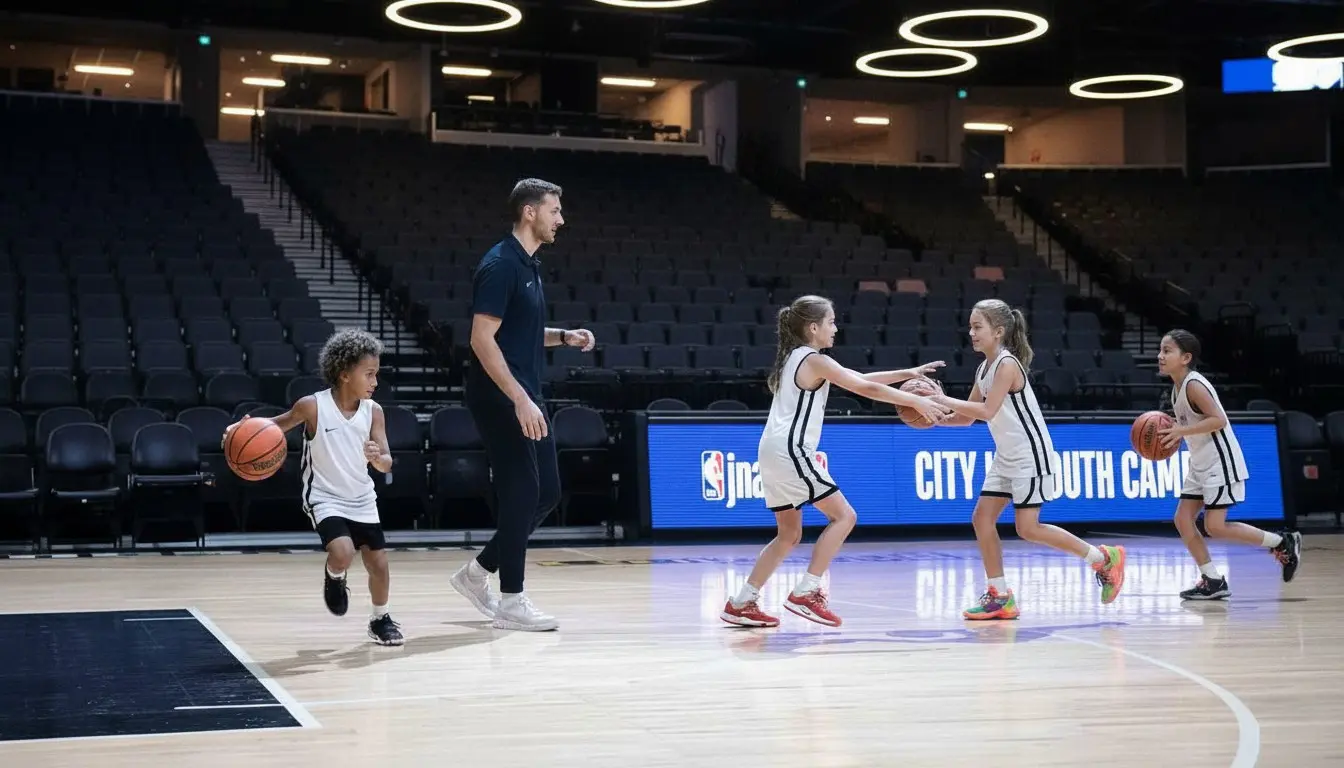
They didn’t need more instruction. They needed better problems.
V. Challenges & Misconceptions – Overcoming Resistance to the CLA
Every coaching revolution faces resistance. The Constraints-Led Approach is no different.
For decades, the “traditional” way has shaped how we think about teaching the game: clear instructions, fixed progressions, and technical drills before gameplay.
When a new approach challenges those habits, skepticism is natural.
1. “Players Need Fundamentals Before They Can Play”
This is the most common misconception, and perhaps the hardest to let go of.
Many coaches believe players must first master the fundamentals in isolation before they’re “ready” to play.
But as the Transforming Basketball Podcast notes in Episode 45 – “Why Basketball Fundamentals Are Outdated”, this logic is backward:
When we train skills outside of the game, we’re practicing movements without the problems those movements were designed to solve.
Fundamentals aren’t ingredients to be pre-taught; they emerge from solving problems within the game.
A child doesn’t learn balance by studying physics, they learn by moving.
In the same way, players develop dribbling, passing, and finishing skills by using them to achieve goals under realistic constraints.
That doesn’t mean we throw beginners into chaos. It means we design environments where success is possible and meaningful.
Example
Use simplified small-sided games like Dribble Tag, where players learn spacing, evasion, and body control naturally.
Or set simple constraints — such as defender starts behind offense — that scale challenge and create immediate success experiences.
2. “It Looks Chaotic”
It does — because basketball is chaotic.
Traditional drills hide that complexity behind order and repetition, but games reveal it.
The goal isn’t to eliminate chaos, but to organize it through design.
As discussed in The Transforming Basketball Podcast, EP 53: “How to Overcome Challenges Implementing the CLA”, chaos is the raw material of learning.
Within well-designed constraints, players learn to adapt, self-organize, and find stability — a concept known as attractor states in skill-acquisition science.
What looks messy is actually a sign of deep learning in progress.
3. “Parents (and Sometimes Coaches) Won’t Understand It”
CLA practices can look unusual, especially when compared to line-based drills that appear more “organized.”
The solution is communication.
Explain why sessions look different and how they connect to actual game improvement.
Invite parents or assistants to observe, show before-and-after clips, or walk them through your design logic.
💡 Practical Tips for a Smooth CLA Transition
- Start small: one CLA drill per practice.
- Explain the *why* behind every constraint.
- Use visuals or short clips to show transfer to real games.
- Involve parents and assistants early.
- Gather feedback, reflect, and adjust continuously.
The Constraints-Led Approach isn’t a dogma — it’s a framework.
It doesn’t demand that you abandon structure; it invites you to redesign it.
Skill acquisition isn’t theory vs practice — it’s science that helps us design better practice.
— The Transforming Basketball Podcast, EP 53 (2024) – Spotify
Ultimately, that’s what modern coaching is all about: not teaching the game we remember, but designing the game our players will create.
VI. The Future of Coaching – From Instructor to Designer
The future of coaching isn’t about louder commands or more drills — it’s about designing environments that let learning emerge.
For too long, coaches equated progress with control — fixing, perfecting, explaining.
Real growth, however, comes from adaptation.
The Constraints-Led Approach (CLA) unites science, intuition, and creativity to form a new kind of coaching: one that builds thinkers, not followers.
The Coach as Designer
In this modern model, the coach becomes a learning architect.
Every constraint, rule, and tweak becomes a design experiment. Coaching shifts from telling to testing, shaping decision-making through discovery.
The Constraints-Led Approach doesn’t limit creativity — it designs for it. (Transforming Basketball Podcast, paraphrased)
The Art of Letting Go
True mastery lies in letting go. Great coaches don’t force answers but listen to what the game reveals.
This balance of freedom and structure turns the gym into a living lab for growth.
💡 Quick Summary: What to Remember from the CLA Revolution
1. Skill is adaptive, not mechanical.
Movements emerge from the interaction between player, task, and environment.
2. The coach designs, not dictates.
Replace instructions with environments that guide discovery.
3. Variability is essential.
Each rep should challenge perception and decision-making, not repeat perfection.
4. Learning is messy — and that’s okay.
Embrace the chaos — it’s the sign that real understanding is forming.
5. The goal isn’t control — it’s connection.
Between players, minds, and the game itself.
The future of basketball coaching lives at the intersection of evidence and emotion,
where structure meets freedom, and science meets creativity.
Don’t teach the move — teach the mind that creates it.
Ready to turn these ideas into a real practice plan?
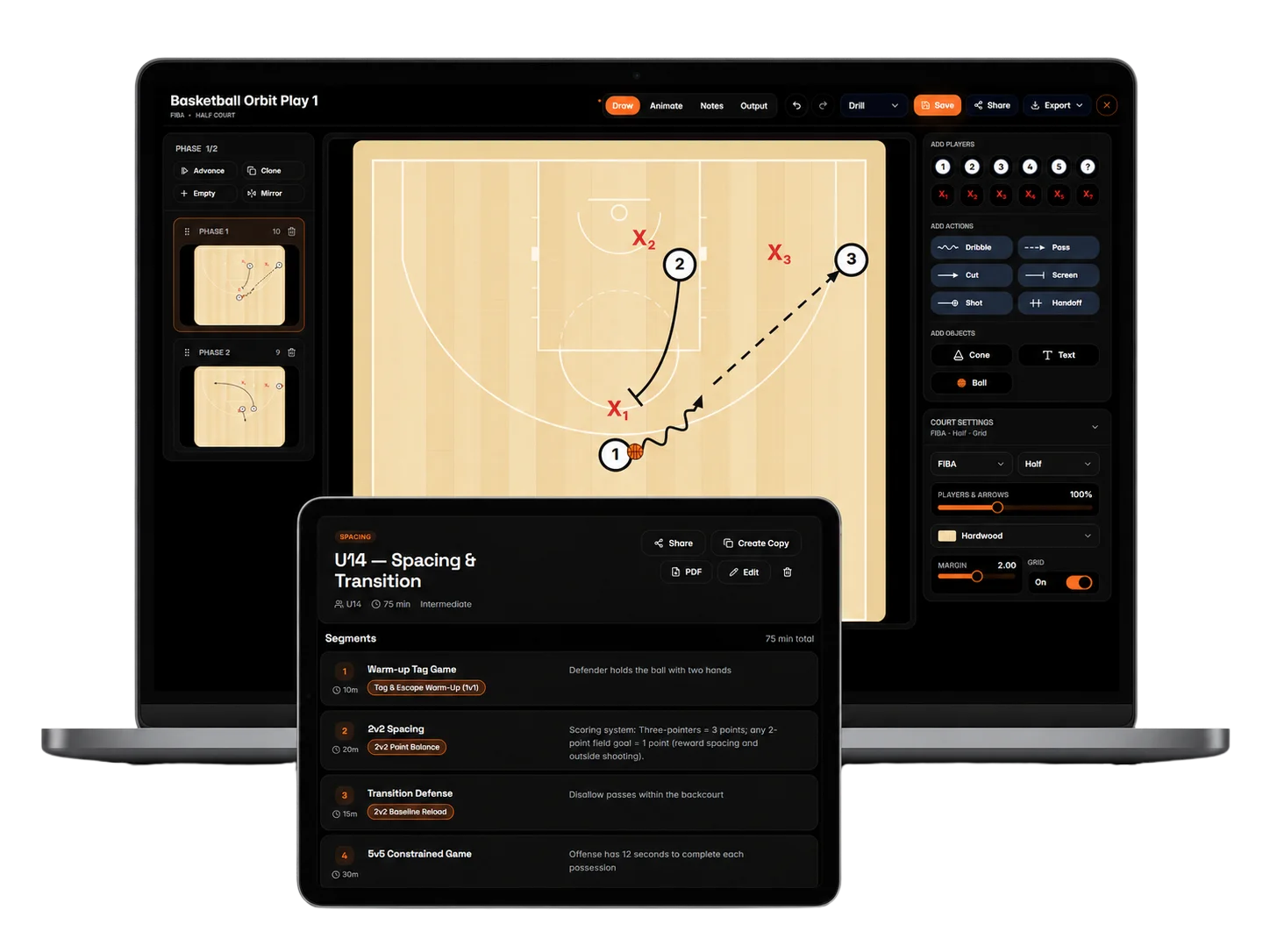
If you want to move beyond disconnected drills and design practices that actually build decision-making, spacing, and player IQ, the Basketball Orbit Practice Planner helps you turn those principles into a complete session:
👉 Basketball Orbit Practice Planner
Create visual drills, organize complete practices, add constraints and coaching notes, and refine the plan with Orbit AI before you step on the court.
Written by Chris Bernhard — Basketball Orbit
© 2025 Basketball Orbit
References:
- Seifert, L., & Davids, K. (2017). Ecological Dynamics: A Theoretical Framework for Understanding Sport Performance, Physical Education, and Physical Activity.
In K. Davids, R. Hristovski, D. Araújo, N. Balagué, & C. Button (Eds.), Complex Systems in Sport (pp. 45–68). Routledge.
ResearchGate - Newell, K. M. (1986). Constraints on the Development of Coordination.
In M. G. Wade & H. T. A. Whiting (Eds.), Motor Development in Children: Aspects of Coordination and Control (pp. 341–360). Springer. - Cassidy, J. (2021). Different Approaches to Skill Acquisition.
Skilled Athleticism Blog - Bonfigli, T. (2019). Applying the Constraints-Led Approach to Basketball Shooting.
Journal of Coaching Science (unofficial preprint).
ResearchGate - Sarama, A., & Klusemann, M. (2024). Transforming Basketball Podcast, Episode 31: How Basketball Coaches Can Create a Culture of Learning with the CLA.
Spotify - Vaz, G. (2025). The Transforming Basketball Podcast, Episode 136: Traditional vs. CLA Drills.
Spotify - Thomas, G., & Sarama, A. (2024). The Transforming Basketball Podcast, Episode 82: What the CLA Is and Isn’t (Part 2).
Spotify