Breaking a press is one of the most frustrating situations for players and coaches.
Everything looks fine on the clipboard.
The spacing is right.
The first option is open.
And then the trap comes — and the play is gone.
That’s because breaking a press is rarely a playbook problem.
It’s a decision-making problem under pressure.
In this article, I’ll walk you through a principle-based approach to breaking any full-court press — man-to-man or zone — and explain why focusing on principles and game-like training prepares your players far better than memorizing set plays.
If you want to see these concepts and training ideas in action, you can watch the full video breakdown here:
Allow marketing cookies to load this YouTube video. Loading it sends data to YouTube.
Watch on YouTube (opens in a new tab)Why Press Break Plays Often Fail
Most press break plays fail for the same reasons.
They rely on perfect timing and clean execution — two things that disappear the moment real pressure is applied.
As soon as the defense:
- denies the first pass,
- changes the angle of the trap, or
- forces the ball handler off their preferred line,
the structure of the play breaks down.
Players hesitate.
They look to the sideline.
They wait for the next instruction instead of reading the game.
At that point, the press has already done its job.
Press defenses are designed to create chaos and speed up decisions.
Set plays don’t survive chaos very well — principles do.
A Principle-Based Way to Break Any Press
Instead of asking players to remember where to stand or when to cut, a principle-based approach focuses on what matters in every press situation.
No matter the alignment, every press tries to:
- take away space,
- limit vision,
- and force rushed decisions.
A principle-based framework prepares players to respond to those problems in real time, even when the situation doesn’t look exactly like it did in practice.
This approach:
- works against man-to-man and zone presses,
- holds up when the defense adjusts,
- and transfers directly from practice to games.
💡 The goal is simple:
prepare players to think under pressure, not memorize patterns.
The 4 Press Break Principles
Every successful press break comes back to the same four ideas.
These principles don’t replace your offense.
They give your players a clear mental framework for handling pressure and recognizing opportunities.
In the sections below, I’ll briefly outline each principle before showing how they can be trained using game-like situations.
1️⃣ Beat the Press Before It’s Set
The press is most vulnerable right after a change of possession.
When the offense transitions quickly from defense to offense, the defense often doesn’t have time to organize its press.
Fast ball retrieval, quick inbounds, and early decisions can create advantages before pressure ever arrives.
This principle isn’t about forcing tempo.
It’s about recognizing moments where going fast naturally puts the defense at a disadvantage.
2️⃣ Pass First, Dribble to Escape
Press defenses want the ball on the floor.
Dribbling allows traps to form, angles to close, and help defenders to rotate.
Passing, on the other hand, forces the defense to move and communicate.
Against pressure, the dribble should be used to escape and create space, not to advance the ball blindly.
Retreat dribbles, strong pivots, and clear passing angles keep the ball alive and prevent panic decisions.
3️⃣ Create Clear Spacing and Passing Lanes
Presses punish poor spacing.
When offensive players are too close together, one defender can guard two.
When they are too far apart, passes become slow and easy to disrupt.
💡 Good spacing creates:
- clearer vision for the ball handler,
- safer passing angles,
- and simple decision-making options under pressure.
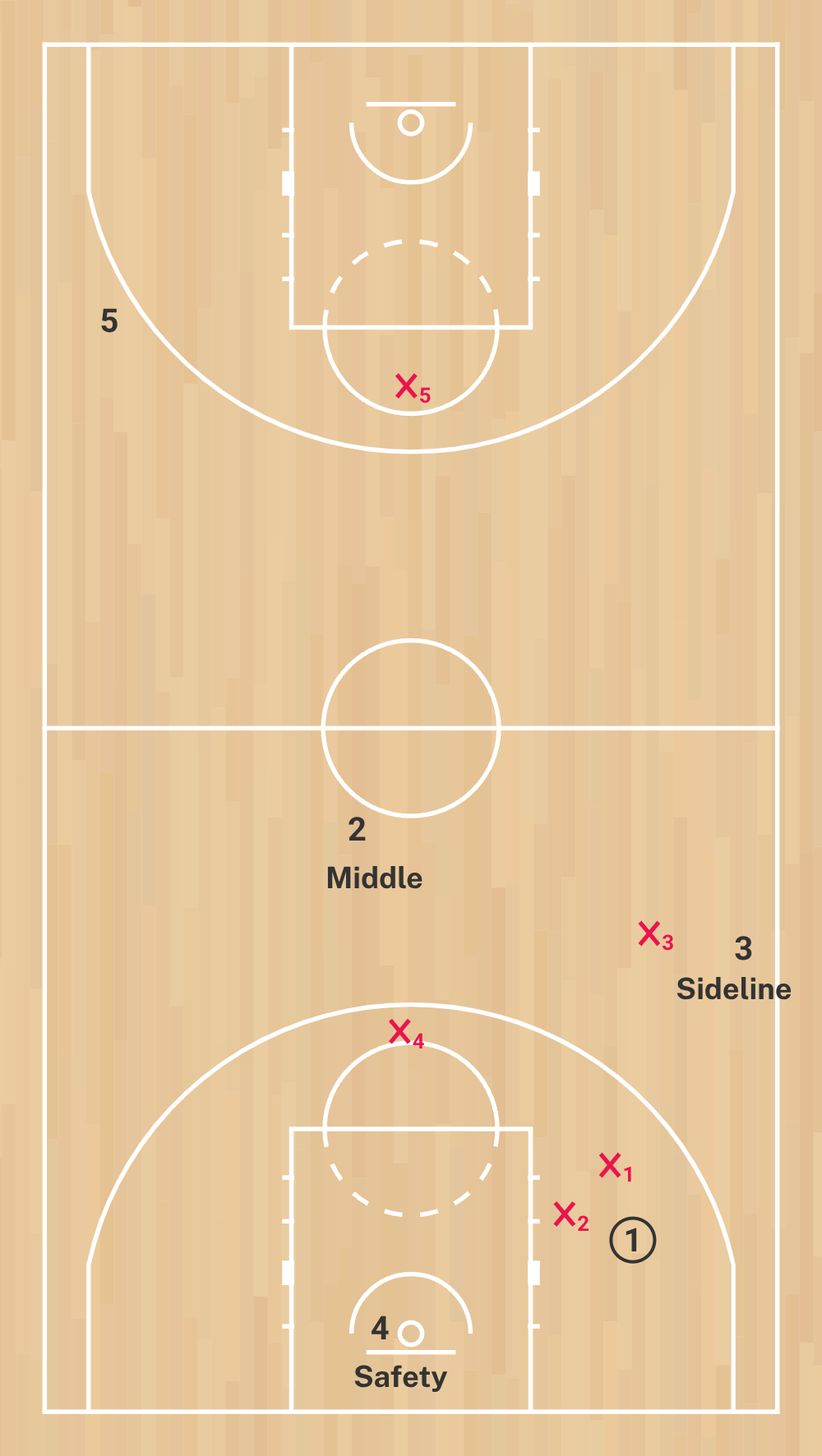
Against zone presses in particular, a simple spacing reference works extremely well:
Sideline – Middle – Safety (SMS).
How it works
- One player [3] stays wide on the sideline.
- One player [2] flashes to the middle.
- One player [4] stays behind the play as a safety.
4️⃣ Recognize and Attack the Advantage
Breaking the press is not the goal.
The real advantage often appears after the ball crosses half court, when the defense is still scrambling, mismatched, or late in its rotations.
Teams that can recognize these moments quickly can turn broken presses into:
- layups,
- catch-and-shoot threes,
- and high-quality scoring opportunities.
If the advantage isn’t there, the best teams don’t force it — they reset and create the next one.
How to Train These Principles (Without Memorizing Plays)
If breaking a press is a decision-making problem,
then training has to look like the game.
That’s why small-sided drills are so effective against pressure.
They put players into realistic situations where spacing, timing, and reads actually matter — without telling them exactly what to do.
Instead of rehearsing patterns, you create constraints that guide behavior:
- limit dribbles to discourage panic,
- add time pressure to force early decisions,
- manipulate space to exaggerate passing lanes,
- reward high-value shots and punish forced ones.
The goal isn’t to control every action.
It’s to shape the environment so the right decisions become the easiest ones.
When players repeatedly solve press situations this way, they stop waiting for instructions.
They recognize cues, communicate naturally, and adapt when the defense changes.
That’s the difference between knowing a press break
and being able to break a press.
If you want to see how these principles are trained step by step using game-like situations,
I walk through all the small-sided games in the full video breakdown here:
👉 Watch the video
Man-to-Man vs. Zone Press: What Actually Changes
The principles stay the same —
but the application looks different depending on the type of pressure.
The key is helping players recognize what the defense is trying to take away,
and responding with the right spacing and decisions — not a new play.
Against Man-to-Man Pressure
Against man-to-man pressure, the main advantage is space.
Once the ball is inbounded, the priority is to clear the backcourt.
That gives the ball handler vision, room to operate, and the ability to read the floor instead of reacting to pressure.
Key adjustments against man-to-man pressure:
- Clear the backcourt to create a true 1-on-1 situation
- Let the ball handler use the full width of the court
- Use the dribble to escape pressure, not to force progress
- Add a simple drag screen only if needed — not as a set play
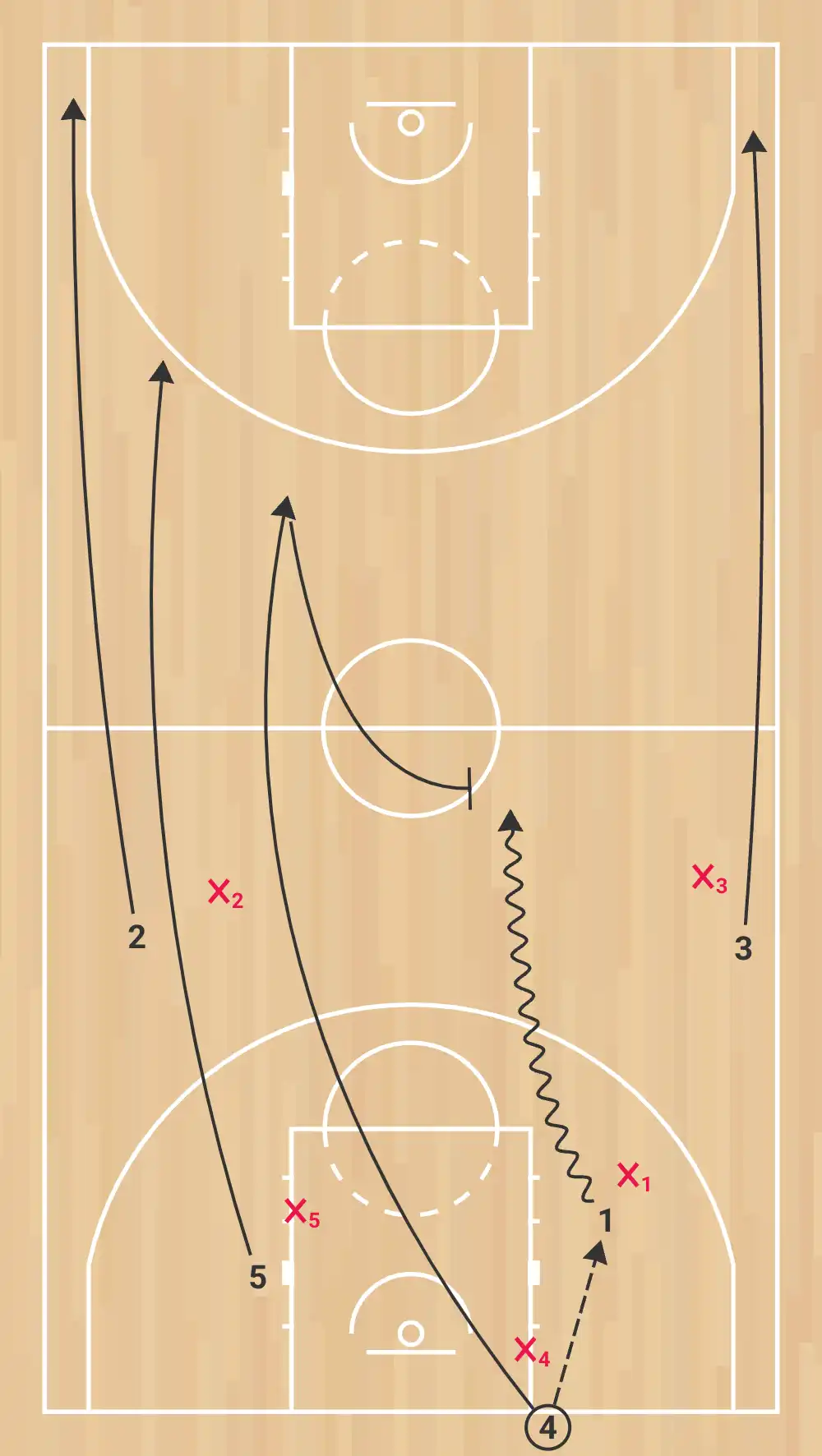
The goal is not to rush, but to give the ball handler time and space to make decisions.
Against Zone Pressure
Against zone pressure, the focus shifts back to passing and collective spacing.
Instead of relying on one player to beat pressure off the dribble,
the offense advances the ball together by creating clear passing lanes and forcing the zone to commit.
The same principles apply — but the solutions are shared across the group, not isolated to the ball handler.
💡 Coaching Reminder
When players understand why spacing and decisions matter,
they don’t need a new press break every time the defense changes.
They simply adjust how they apply the same principles.
Free Resource: Press Break Framework PDF
Want a clear framework to break any press?
Stop relying on press break plays that fall apart under pressure. This free PDF organizes the key principles behind breaking any full-court press — man-to-man or zone — into a simple, coach-friendly framework.
👉 Download the Press Break Framework (PDF)
A principle-based resource built around decision-making, spacing, and game-like training — designed for real game transfer.
Conclusion
Breaking a press is not about having the perfect answer.
It’s about preparing your players to stay calm, recognize space, and make connected decisions under pressure.
When teams stop relying on memorized plays and start training principles in game-like situations, press defenses lose their power.
What once felt chaotic becomes manageable — and often an opportunity.
If you want to see how these principles are trained in practice, make sure to watch the full video.
And if you’re looking for a clear way to organize everything for practice and game day, the Press Break Framework PDF gives you that structure.
Train the game.
Trust the principles.
Let your players solve the problem.
Written by Chris Bernhard — Basketball Orbit
© 2026 Basketball Orbit